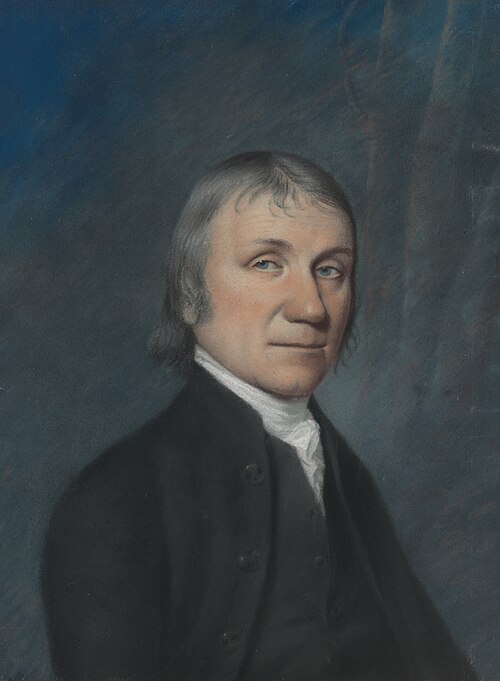
Joseph Priestley, portrait by James Sharples, 1797James Sharples, 1797. Public domain. Wikimedia Commons. Image source
Joseph Priestley isolates a remarkable air
1774 to 1775 · Joseph Priestley (1733 to 1804)
Joseph Priestley was an English minister, teacher and scientist with a deep interest in different kinds of air, which we now call gases.
On 1 August 1774 he used a large lens to focus sunlight onto a red powder called mercuric oxide. It gave off a gas. A candle burned in it with a strong flame, and a mouse lived longer in a sealed container of it than in ordinary air.
Priestley breathed some himself and wrote that his chest felt light and easy for some time afterward. He even wondered whether it might help the lungs in some illnesses, but warned that it might also be used up too quickly by the body.
The Swedish chemist Carl Wilhelm Scheele had made the same gas a little earlier, and the French chemist Antoine Lavoisier explained its role and named it oxygen.
Today oxygen is one of the most common drugs given in hospitals. Priestley's caution was wise: respiratory therapists titrate oxygen to a target saturation rather than giving as much as possible.
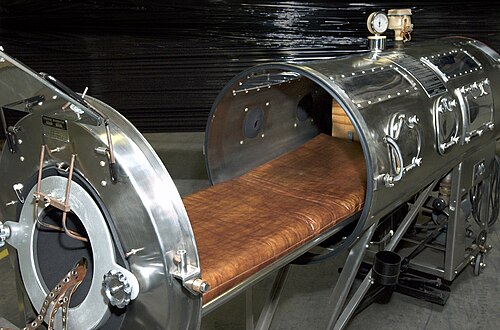
An iron lung, CDC Public Health Image LibraryPhoto Credit: Content Providers(s): CDC/GHO/Mary Hilpertshauser, 2004-12-17. Public domain. Wikimedia Commons. Image source
The iron lung keeps polio patients breathing
1928 to 1955 · Philip Drinker (1894 to 1972) and Louis Agassiz Shaw
Polio could paralyse the muscles used for breathing. Before the late 1920s, many patients with this kind of polio died.
In 1928 Philip Drinker and Louis Agassiz Shaw at Harvard built a large metal tank. The patient lay inside with only the head outside, sealed at the neck. Pumps lowered the pressure in the tank so the chest expanded and air flowed in, then raised it so air flowed out. This is called negative-pressure ventilation.
Its first use, on a young girl in Boston, showed it could keep someone breathing. Cheaper designs followed, and during polio epidemics in the 1930s to 1950s hospitals filled wards with iron lungs. Canada saw big epidemics, including one in 1953.
In the 1950s, during an epidemic in Copenhagen, teams kept patients alive by squeezing bags by hand through a tracheostomy. This positive-pressure approach led to the modern ventilator and the intensive care unit.
Polio vaccines arriving from 1955 made iron lungs rare. Respiratory therapists now run the positive-pressure ventilators that replaced them.